---
title: NetSuite point of sale integration without friction
description: NetSuite point of sale integration unifies inventory, sales, and finance in real time to reduce errors and accelerate decisions.
image: https://afocirmbqdxnkyescnev.supabase.co/storage/v1/object/public/featured-images/74dd8729-2ce0-4fea-b7eb-3947a9758545/a2ad82fb-d210-4b1a-8580-4b2607a1dc44.webp
---
English
- English
- [Español](https://www.efficientix.com/es/blog/integracion-netsuite-punto-de-venta)
Send us a Message: [+1 786 546 6255](https://wa.me/17865466255)
Más resultados
[Access NetSuite](https://system.netsuite.com/pages/customerlogin.jsp?country=MX) [Contact Us](https://www.efficientix.com/en/contact?hsLang=en) [Access Support](https://www.efficientix.com/en/efficientix-technical-support?hsLang=en)
[](https://www.efficientix.com/?hsLang=en)
[](https://www.efficientix.com/?hsLang=en)
- [Home](https://www.efficientix.com/en/)
- NetSuite
- [NetSuite ERP](https://www.efficientix.com/en/netsuite-erp)
- [NetSuite EPM](https://www.efficientix.com/en/epm-netsuite)
- [NetSuite NSAW](https://www.efficientix.com/en/netsuite-nsaw)
- Partnerships
- [Integrations](https://www.efficientix.com/en/celigo-netsuite-integrator)
- [Point Of Sale](https://www.efficientix.com/en/zoku-pos-netsuite)
- [E-Commerce](https://www.efficientix.com/en/shopify-netsuite)
- [Manteinance Management](https://www.efficientix.com/en/shepherd-netsuite)
- [Human Resources](https://www.efficientix.com/en/software-rrhh)
- [Efficientix +](https://www.efficientix.com/apps-efficientix-for-netsuite)
- [Mexican Tax Localization](https://www.efficientix.com/en/netsuite-mexico-localization)
- [Mobile Sales App](https://www.efficientix.com/en/mobile-sales-app)
- [Expense Management App](https://www.efficientix.com/en/expense-management-app-netsuite)
- [Tax Suite](https://www.efficientix.com/en/tax-suite-netsuite)
- [Ask NetSuite](https://www.efficientix.com/en/ask-netsuite-ai-assistant)
- [POS](https://www.efficientix.com/en/point-of-sale-pos-netsuite)
- Industries
- [Financial Services](https://www.efficientix.com/en/erp-fintech)
- [Food & Beverage](https://www.efficientix.com/en/erp-food-beverage)
- [Livestock](https://www.efficientix.com/en/livestock-for-netsuite)
- [Manufacturing](https://www.efficientix.com/en/erp-manufacturing)
- [Pharmaceutical Distributor](https://www.efficientix.com/en/erp-medical-distributors)
- [Professional Services](https://www.efficientix.com/en/erp-professional-services)
- [Renewable Energy](https://www.efficientix.com/en/erp-renewable-energy)
- [Retail](https://www.efficientix.com/en/erp-retail)
- [StartUps](https://www.efficientix.com/en/erp-startups)
- [Transportation](https://www.efficientix.com/en/erp-transportation-mexico)
- [Telecommunications](https://www.efficientix.com/en/erp-for-telecommunications)
- [Wholesale](https://www.efficientix.com/en/erp-wholesale)
- Resources
- [Blog](https://www.efficientix.com/en/blog)
- [Success Stories](https://www.efficientix.com/en/success-stories)
- [EFX Learning](https://www.efficientix.com/en/efx-learning)
- About Us
- [Efficientix Services](https://www.efficientix.com/en/services-netsuite)
- [Efficientix Support](https://www.efficientix.com/en/support-netsuite)
- [About Efficientix](https://www.efficientix.com/en/about-us)
- [Contact](https://www.efficientix.com/en/contact)
En
- English
- [Español](https://www.efficientix.com/es/blog/integracion-netsuite-punto-de-venta)
More results
- [Home](https://www.efficientix.com/en/)
- NetSuite
- [NetSuite ERP](https://www.efficientix.com/en/netsuite-erp)
- [NetSuite EPM](https://www.efficientix.com/en/epm-netsuite)
- [NetSuite NSAW](https://www.efficientix.com/en/netsuite-nsaw)
- Partnerships
- [Integrations](https://www.efficientix.com/en/celigo-netsuite-integrator)
- [Point Of Sale](https://www.efficientix.com/en/zoku-pos-netsuite)
- [E-Commerce](https://www.efficientix.com/en/shopify-netsuite)
- [Manteinance Management](https://www.efficientix.com/en/shepherd-netsuite)
- [Human Resources](https://www.efficientix.com/en/software-rrhh)
- [Efficientix +](https://www.efficientix.com/apps-efficientix-for-netsuite)
- [Mexican Tax Localization](https://www.efficientix.com/en/netsuite-mexico-localization)
- [Mobile Sales App](https://www.efficientix.com/en/mobile-sales-app)
- [Expense Management App](https://www.efficientix.com/en/expense-management-app-netsuite)
- [Tax Suite](https://www.efficientix.com/en/tax-suite-netsuite)
- [Ask NetSuite](https://www.efficientix.com/en/ask-netsuite-ai-assistant)
- [POS](https://www.efficientix.com/en/point-of-sale-pos-netsuite)
- Industries
- [Financial Services](https://www.efficientix.com/en/erp-fintech)
- [Food & Beverage](https://www.efficientix.com/en/erp-food-beverage)
- [Livestock](https://www.efficientix.com/en/livestock-for-netsuite)
- [Manufacturing](https://www.efficientix.com/en/erp-manufacturing)
- [Pharmaceutical Distributor](https://www.efficientix.com/en/erp-medical-distributors)
- [Professional Services](https://www.efficientix.com/en/erp-professional-services)
- [Renewable Energy](https://www.efficientix.com/en/erp-renewable-energy)
- [Retail](https://www.efficientix.com/en/erp-retail)
- [StartUps](https://www.efficientix.com/en/erp-startups)
- [Transportation](https://www.efficientix.com/en/erp-transportation-mexico)
- [Telecommunications](https://www.efficientix.com/en/erp-for-telecommunications)
- [Wholesale](https://www.efficientix.com/en/erp-wholesale)
- Resources
- [Blog](https://www.efficientix.com/en/blog)
- [Success Stories](https://www.efficientix.com/en/success-stories)
- [EFX Learning](https://www.efficientix.com/en/efx-learning)
- About Us
- [Efficientix Services](https://www.efficientix.com/en/services-netsuite)
- [Efficientix Support](https://www.efficientix.com/en/support-netsuite)
- [About Efficientix](https://www.efficientix.com/en/about-us)
- [Contact](https://www.efficientix.com/en/contact)
[Access NetSuite](https://system.netsuite.com/pages/customerlogin.jsp?country=MX)[Contact Us](https://www.efficientix.com/en/contact?hsLang=en)
Contáctanos: **[+52 55 8041 6312](https://wa.me/525580416312)**
Correo:[**info@efficientix.com**](mailto:info@efficientix.com)
# NetSuite point of sale integration without friction
By [**Christian Salas**](https://www.efficientix.com/en/blog/author/christian-salas) on May 14, 2026, 11:48:58 AM
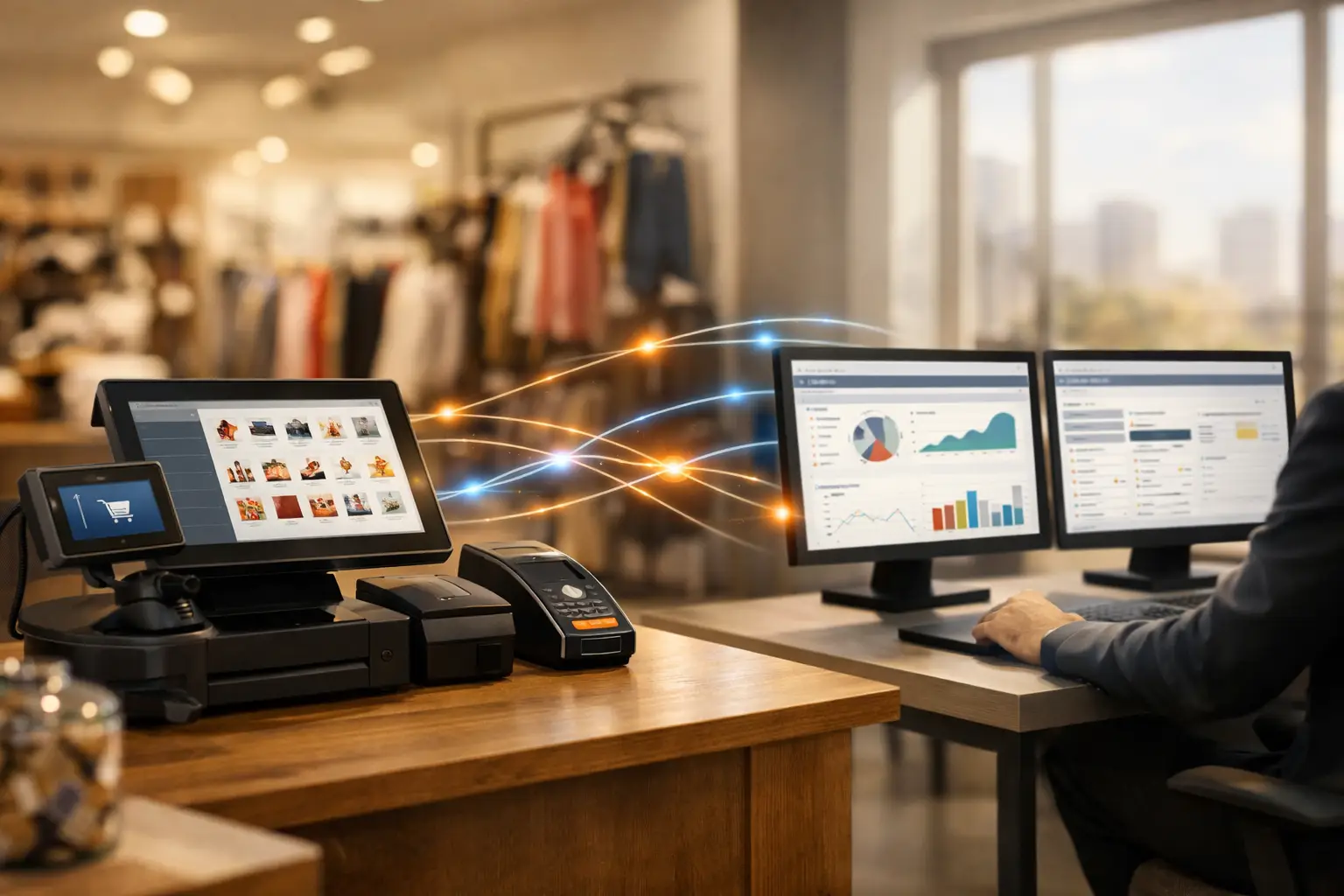
When a store sells a product that the ERP does not yet recognize as having left, the problem is not at the checkout. It is in the entire operation. That is where NetSuite point of sale integration stops being an IT project and becomes a decision of financial control, inventory, and growth.
In retail and distribution with over-the-counter service, symptoms usually appear quickly: inventory discrepancies, slow end-of-day closes, sales recorded in one system and returns in another, promotions that do not match accounting, and reports that arrive too late to make decisions. If you also operate multiple branches, different warehouses, or a combination of physical and e-commerce sales, fragmentation becomes expensive.
The good news is that this problem has a solution. The not-so-good news is that not all integrations solve the same thing. Some only send receipts; others truly synchronize operations, finance, and inventory. That difference defines whether the point of sale supports growth or becomes a bottleneck.
## What a NetSuite point of sale integration solves
The integration between [NetSuite](https://www.efficientix.com/es/netsuite-erp?hsLang=en) and a well-designed POS connects the moment of sale with the rest of the business. It is not just about passing information from one platform to another, but about maintaining operational consistency in processes that impact cash flow, margins, and customer service.
In practice, this means that a store sale can update inventory, record revenue, apply configured taxes, recognize payment methods, and leave traceability for reconciliation. When the design is right, it also allows managing returns, exchanges, layaways, authorized discounts, and transfers between branches without relying on manual reconciliations at the end of the day.
For a CFO, the value lies in a more orderly close and fewer subsequent adjustments. For operations, it is in the real visibility of stock. For IT, in reducing isolated interfaces and points of failure. And for general management, in a more solid foundation for opening new stores or integrating new channels without multiplying systems.
## Where most POS integration projects with NetSuite fail
The most common mistake is thinking that integration starts with the interface and not the process. If the checkout is connected first and then an attempt is made to figure out how to account for a return, how to control reserved inventory, or how to settle mixed payments, the project ends up patching exceptions.
We also see failures when local operations are underestimated. In Mexico and LATAM, for example, the reality includes tax issues, rounding rules, complex commercial promotions, extensive catalogs, offline operation in some branches, and internal audit needs that are not always considered in a generic integration.
Another critical point is latency. There are processes that must be reflected almost in real time, such as inventory availability by store. Others can be consolidated by batch without affecting the operation, such as certain aggregated accounting entries. Forcing real time for everything can make the architecture more expensive and complicated without adding value. Doing everything by batch, on the other hand, can leave the business operating with outdated information. There is no universal recipe here. It depends on the volume, the commercial model, and the level of control you are looking for.
## How to evaluate a NetSuite point of sale integration
The right conversation doesn't start with isolated features, but with operational scenarios. Do you sell from the store against local or shared inventory? Do you do click and collect? Can a return be made at a different branch than the original sale? Do you manage price lists by channel, customer, or season? Do you need to operate if the internet goes down?
With those answers, the evaluation moves to another level. You are no longer buying "a POS connected to the ERP," but defining how critical business information will flow. Here it is advisable to review at least five fronts: item master, inventory, prices and promotions, payments and accounting, and the store operation experience.
The item master must avoid duplicates and ensure that codes, variants, taxes, and units are aligned. In inventory, you must decide which movements update stock online and which follow a validation or consolidation logic. In pricing, it matters that business rules do not live isolated from the rest of the business. In payments, the detail is in the reconciliation, not just in collecting. And in the store, a fast interface is worth as much as the stability of the data it sends to the ERP.
### Real time vs consolidation
One of the most relevant debates in a NetSuite point of sale integration is what should travel in real time. If your operation depends on instant visibility for assortment, replenishment, or delivery promises, it is best to prioritize the immediate synchronization of sales and inventory. If the focus is on simplifying high-volume accounting, it may make more sense to consolidate transactions under well-defined rules.
The important thing is to avoid extremes. A serious design distinguishes critical events from administrative events. That separation improves performance, facilitates support, and reduces incidents at go-live.
### Omnichannel operation without fictitious inventory
The problem with many omnichannel strategies is not commercial. It's a data problem. If e-commerce shows available stock that the store has already sold, the customer experience is broken, and the operational cost appears later in cancellations, refunds, and rework.
Therefore, the integration between POS and NetSuite must include a single operational version of inventory or, at least, clear rules on priority, reservation, and update by channel. An absolute single inventory is not always necessary, but a unified logic that the business can understand and audit is.
## Real benefits when the project is done right
A well-executed integration reduces manual entry and reconciliation errors, but that is only the first level. The most valuable impact is usually seen in decision-making speed. When sales, inventory, and finance share a reliable foundation, it is easier to detect stockouts, measure profitability by branch, adjust purchases, and weed out promotions that erode margins.
Furthermore, it improves scalability. Opening a new store no longer involves creating parallel processes or relying on spreadsheets to close the month. And that is especially important for companies that are growing, integrating new business units, or professionalizing their operations after years of making do with disconnected systems.
In well-governed projects, the financial team's effort at close is also reduced. Fewer adjustments, fewer manual cross-checks, more traceability. It doesn't mean supervision disappears, but rather that supervision is done on real exceptions and not on thousands of scattered transactions.
## What management should ask of the project team
If you are part of the purchasing committee or leading the transformation, it is advisable to ask for concrete definitions from the start. A smooth checkout demo is not enough. You need to understand what happens with a partial cancellation, a mixed payment, a credit memo, an offline sale, a store transfer, or a promotion with special rules.
It is also advisable to demand a clear implementation path. Scope, assumptions, dependencies, testing criteria, training plan, and go-live strategy. In our experience, time-to-value improves when knee-jerk customizations are avoided and well-configured standard processes are prioritized, with localization and extensions only where they truly add value.
For companies in Mexico, this point is especially sensitive. Integration cannot be analyzed in isolation from [tax and accounting requirements](https://www.efficientix.com/es/localizacion-netsuite-mexico?hsLang=en). The POS sells, but [the ERP](https://www.efficientix.com/es/blog/erp-inteligente-negocios?hsLang=en) records, consolidates, and supports the traceability of the operation. When both worlds are designed separately, the cost appears later.
## When is the right time to integrate
There are usually three triggers. The first is growth: more branches, more transactions, more channels. The second is control: unreliable inventories, slow closes, accounting discrepancies, or low visibility per store. The third is a platform change: migrating to NetSuite from legacy systems or tools that no longer support business complexity.
Waiting too long is usually expensive. Not because the integration is urgent in itself, but because every month with fragmented processes leaves more exceptions, more rework, and less capacity to scale with order. Even so, it is not advisable to rush without a design either. A good POS integration project accelerates not just by connecting systems, but by properly defining the process before go-live.
At Efficientix, we see it this way: technology adds value when it orders operations and makes them measurable. If your point of sale still lives separately from the ERP, you are not facing a technical detail. You are facing a direct opportunity to improve control, service, and profitability with an architecture designed to grow.
Share this
[Share on X](https://x.com/intent/post?url=https://www.efficientix.com/en/blog/integration-netsuite-point-of-sale&text=NetSuite+point+of+sale+integration+without+friction) [Share on Facebook](https://www.facebook.com/sharer/sharer.php?u=https://www.efficientix.com/en/blog/integration-netsuite-point-of-sale&t=NetSuite+point+of+sale+integration+without+friction) [Share on LinkedIn](https://www.linkedin.com/shareArticle?mini=true&url=https://www.efficientix.com/en/blog/integration-netsuite-point-of-sale&t=NetSuite+point+of+sale+integration+without+friction)
Previous story
[← NetSuite integration with ecommerce without friction](https://www.efficientix.com/en/blog/integration-netsuite-with-ecommerce?hsLang=en)
Next story
[NetSuite for discrete manufacturing: what it solves →](https://www.efficientix.com/en/blog/netsuite-for-discrete-manufacturing?hsLang=en)
## You May Also Like
These Related Stories
[How to unify sales, inventory, and finance](https://www.efficientix.com/en/blog/how-to-unify-sales-inventory-finance?hsLang=en)

### How to unify sales, inventory, and finance
May 15, 2026, 8:36:36 AM 5 min read
[Mobile Sales App for NetSuite: real-time field sales](https://www.efficientix.com/en/blog/mobile-sales-app-netsuite?hsLang=en)

[App](https://www.efficientix.com/en/blog/tag/app)
### Mobile Sales App for NetSuite: real-time field sales
Feb 9, 2026, 3:16:15 PM 4 min read
[Oracle NetSuite: the operational foundation of the modern business](https://www.efficientix.com/en/blog/oracle-netsuite-la-base-operativa-del-negocio-moderno?hsLang=en)

[CEO](https://www.efficientix.com/en/blog/tag/ceo)
### Oracle NetSuite: the operational foundation of the modern business
Jan 27, 2026, 1:26:27 PM 4 min read
[](https://www.efficientix.com/es/inicio?hsLang=en)
##### Oracle NetSuite Partner in USA, Mexico, LATAM and Caribbean.
[mailto:info@efficientix.com](mailto:info@efficientix.com)
NetSuite ERP
- [Cloud ERP + AI](https://www.efficientix.com/en/netsuite-erp?hsLang=en)
- [Performance Management](https://www.efficientix.com/en/epm-netsuite?hsLang=en)
- [Analytics Warehouse](https://www.efficientix.com/en/netsuite-nsaw?hsLang=en)
- [NetSuite Consultancy](https://www.efficientix.com/en/services-netsuite?hsLang=en)
- [NetSuite Support](https://efficientix.zendesk.com/hc/es-419)
- [Mexican Tax Localization](https://www.efficientix.com/en/netsuite-mexico-localization?hsLang=en)
NetSuite Industries
- [Retail](https://www.efficientix.com/en/erp-retail?hsLang=en)
- [Manufacturing](https://www.efficientix.com/en/erp-manufacturing?hsLang=en)
- [Wholesale](https://www.efficientix.com/en/erp-wholesale?hsLang=en)
- [Startups](https://www.efficientix.com/en/erp-startups?hsLang=en)
- [Food and Beverage](https://www.efficientix.com/en/erp-food-beverage?hsLang=en)
- [Renewable Energy](https://www.efficientix.com/en/erp-renewable-energy?hsLang=en)
- [Medical Distribution](https://www.efficientix.com/en/erp-medical-distributors?hsLang=en)
- [Fintech](https://www.efficientix.com/en/erp-fintech?hsLang=en)
- [Professional Services](https://www.efficientix.com/en/erp-professional-services?hsLang=en)
Resources
- [Blog SuiteSuccess](https://efficientix.com/en/blog?hsLang=en)
- [Guides & Dossiers](https://www.efficientix.com/es/efx-learning?hsLang=en)
- Success Stories
- [Help Desk](https://efficientix.zendesk.com/)
- [NetSuite Login](https://system.netsuite.com/pages/customerlogin.jsp)
About Efficientix
- Our Story
- [Join to our team](mailto:rh@efficientix.com)
- [Contact](https://www.efficientix.com/en/contact?hsLang=en)
- [Send us a message](https://wa.me/17869840191?text=I%20want%20to%20know%20more%20about%20efficientix)
Copyright © 2026 Efficientix | USA and Caribbean
- [Privacy Note](https://www.efficientix.com/hubfs/Descargables%202025%20EFX/Efficientix%20-%20Privacy%20Policy%202025.pdf?hsLang=en)
- [1101 Brickell Ave Tower, 8th Floor-2A, Miami, FL 33131, United States](https://maps.app.goo.gl/9zvhcmBoEAnLJEB87)
```json
{
"@context" : "https://schema.org",
"@type" : "BlogPosting",
"author" : {
"@type" : "Person",
"name" : "Christian Salas",
"url" : "https://www.efficientix.com/en/blog/author/christian-salas"
},
"dateModified" : "2026-05-14T17:48:58.517Z",
"datePublished" : "2026-05-14T17:48:58.000Z",
"headline" : "NetSuite point of sale integration without friction",
"image" : [ "https://afocirmbqdxnkyescnev.supabase.co/storage/v1/object/public/featured-images/74dd8729-2ce0-4fea-b7eb-3947a9758545/a2ad82fb-d210-4b1a-8580-4b2607a1dc44.webp" ],
"mainEntityOfPage" : {
"@id" : "https://www.efficientix.com/en/blog/integration-netsuite-point-of-sale",
"@type" : "WebPage"
},
"publisher" : {
"@type" : "Organization",
"logo" : {
"@type" : "ImageObject",
"url" : "https://www.efficientix.com/hubfs/Efficientix%20Color%20NS%20Partner%20Web.png"
},
"name" : "Free Bug S de RL de CV"
}
}
```
```json
{
"@context" : "https://schema.org",
"@type" : "Organization",
"contactPoint" : [ {
"@type" : "ContactPoint",
"areaServed" : [ "México", "Guatemala", "El Salvador", "Honduras", "Costa Rica", "Panamá", "Perú", "Colombia" ],
"availableLanguage" : [ "es", "en" ],
"contactType" : "sales",
"telephone" : "+525580416312",
"url" : "https://www.efficientix.com/es/contacto"
}, {
"@type" : "ContactPoint",
"areaServed" : [ "United States", "Belice", "Dominica", "Jamaica", "Republica Dominicana", "Puerto Rico", "Trinidad y Tobago" ],
"availableLanguage" : [ "es", "en" ],
"contactType" : "sales",
"telephone" : "+17865466255",
"url" : "https://www.efficientix.com/en/contact"
} ],
"description" : "Efficientix es una consultora de software empresarial especializada en la implementación de Oracle NetSuite. Simplificamos la gestión empresarial para mejorar la eficiencia operativa de las empresas.",
"founder" : {
"@type" : "Person",
"alumniOf" : "ITAM",
"image" : "https://www.efficientix.com/hubfs/Fotos%20Colaboradores%202025/Efficientix/Christian%20Salas.png",
"jobTitle" : "Fundador y Director General",
"name" : "Christian Salas",
"sameAs" : "https://www.linkedin.com/in/christiansalas"
},
"foundingDate" : "2010",
"knowsAbout" : [ "Retail", "Manufacturing", "Wholesale Distribution", "Professional Services", "Health", "Renewable Energy Projects", "Technology Startups" ],
"location" : [ {
"@type" : "Place",
"address" : {
"@type" : "PostalAddress",
"addressCountry" : "MX",
"addressLocality" : "Ciudad de México",
"addressRegion" : "CDMX",
"postalCode" : "05100",
"streetAddress" : "Camino al Olivo 15, Lomas de Vista Hermosa"
},
"hasMap" : "https://maps.app.goo.gl/UEMKL4x3bQkyLkq5A",
"name" : "Efficientix CDMX"
}, {
"@type" : "Place",
"address" : {
"@type" : "PostalAddress",
"addressCountry" : "US",
"addressLocality" : "Miami",
"addressRegion" : "FL",
"postalCode" : "33131",
"streetAddress" : "1101 Brickell Ave South Tower, 8th Floor-2A"
},
"hasMap" : "https://maps.app.goo.gl/HhYmnedBvwKWjYUU6",
"name" : "Efficientix Miami"
}, {
"@type" : "Place",
"address" : {
"@type" : "PostalAddress",
"addressCountry" : "US",
"addressLocality" : "San Antonio",
"addressRegion" : "TX",
"postalCode" : "78216",
"streetAddress" : "400 Portland Rd Building #2 Suite 106"
},
"hasMap" : "https://maps.app.goo.gl/n3kXx5or3GySDr47A",
"name" : "Efficientix San Antonio"
} ],
"logo" : "https://www.efficientix.com/hs-fs/hubfs/Logos/Logo%20Efficientix%20Semi%20Blanco%20-PNG.png",
"makesOffer" : [ {
"@type" : "Offer",
"itemOffered" : {
"@type" : "Service",
"name" : "SuiteFoundations"
}
}, {
"@type" : "Offer",
"itemOffered" : {
"@type" : "Service",
"name" : "Multibook NetSuite"
}
}, {
"@type" : "Offer",
"itemOffered" : {
"@type" : "Service",
"name" : "Tax Localization for Mexico"
}
}, {
"@type" : "Offer",
"itemOffered" : {
"@type" : "Service",
"name" : "SuiteSuccess"
}
}, {
"@type" : "Offer",
"itemOffered" : {
"@type" : "Service",
"name" : "NetSuite Implementation"
}
}, {
"@type" : "Offer",
"itemOffered" : {
"@type" : "Service",
"name" : "NetSuite Integrations"
}
} ],
"name" : "Efficientix",
"sameAs" : [ "https://www.linkedin.com/company/efficientix", "https://www.youtube.com/channel/UCNp7plLsWjCnRPedphTR36g", "https://www.instagram.com/efficientix", "https://www.facebook.com/efficientix.mx" ],
"url" : "https://www.efficientix.com"
}
```
```json
{
"@context" : "https://schema.org",
"@type" : "BreadcrumbList",
"itemListElement" : [ {
"@type" : "ListItem",
"item" : "https://www.efficientix.com/es/",
"name" : "Inicio",
"position" : 1
}, {
"@type" : "ListItem",
"item" : "https://www.efficientix.com/es/blog/",
"name" : "Blog",
"position" : 2
} ]
}
```