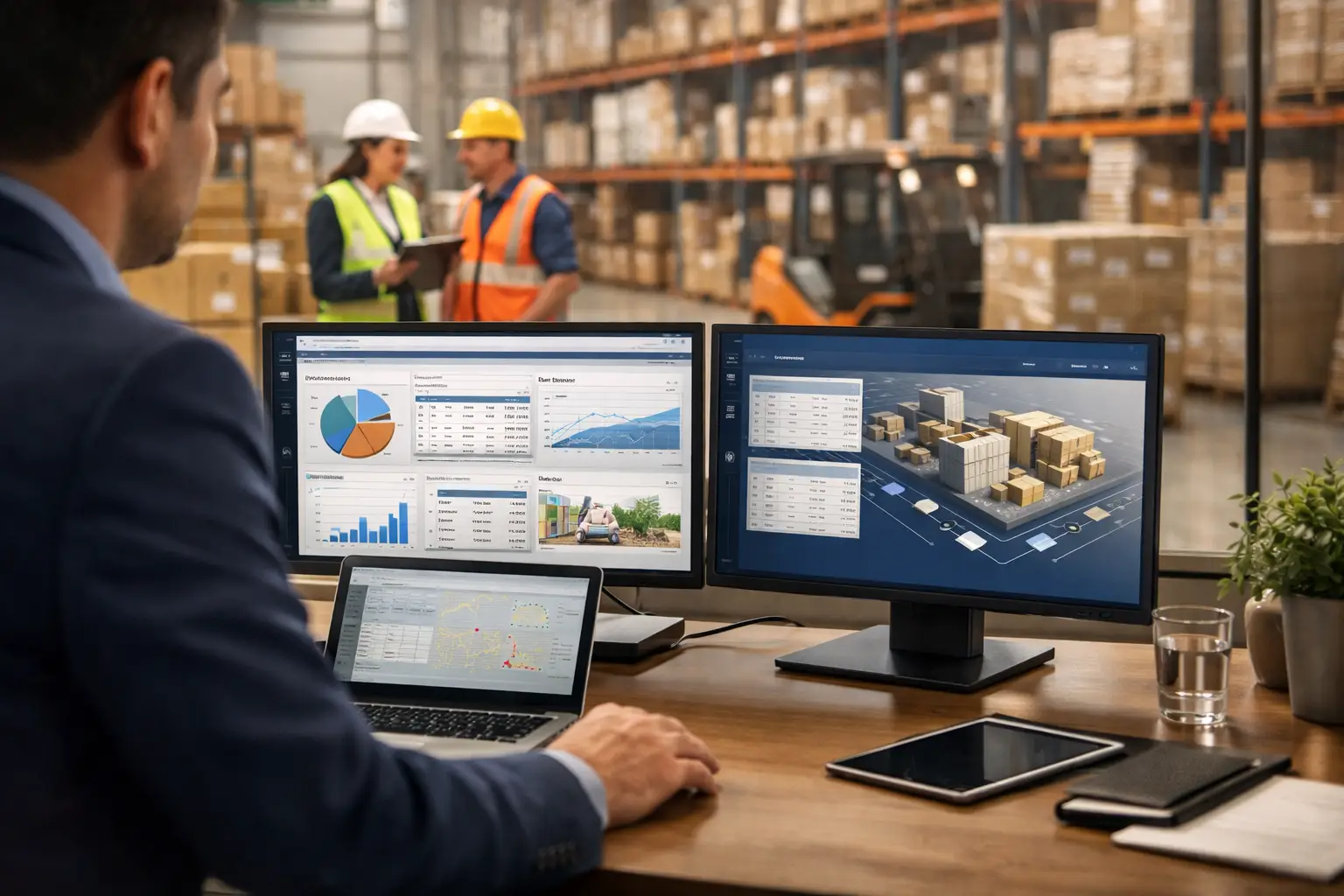
The global landscape is changing faster than companies can react.
The current global context no longer allows for pauses. The combination of accelerated technological advances, constant regulatory changes, economic pressure, and increasingly high expectations from customers and markets has completely redefined how companies operate. Today, change is no longer an extraordinary event — it is the norm.
In this scenario, many organizations continue to grow, but internally they begin to feel friction. Processes that once worked are now strained, decisions that were once made calmly now arrive too late, and systems that once seemed sufficient begin to show their limits. The real risk is not change itself, but not being prepared to absorb it without losing control.
Competitive advantage no longer belongs only to those who innovate the fastest, but to those who manage to turn constant change into a stable, predictable, and scalable operation.
Artificial intelligence: from technological trend to business infrastructure
Artificial intelligence is no longer a futuristic promise or a topic reserved for large tech corporations. Today, it is a transversal layer that is transforming how companies make decisions, execute processes, and scale operations. From intelligent assistants to advanced predictive models, AI has quietly integrated into daily business operations.
What truly matters is not the technology itself, but the mindset shift it creates. Organizations are moving from reactive models, based on historical reports, to predictive and preventive models, where decisions are supported by patterns, scenarios, and probabilities.
This evolution is already impacting critical areas such as financial planning, inventory management, risk management, customer relationships, and operational efficiency. As AI becomes a standard, it raises the competitive threshold: companies that cannot integrate it begin to lose ground, even if they do not immediately notice it.
A new global technological context that redefines business operations
Artificial intelligence does not advance alone. It is part of a broader technological ecosystem that is pushing companies toward a new operational standard. At a global level, there are clear consensuses: the cloud has stopped being an alternative and has become the foundation; real-time data has shifted from being a differentiator to a requirement; and automation is no longer optional.
Additionally, technological resilience has become strategic. In a volatile environment, systems must adapt quickly to market changes, supply chain disruptions, or regulatory adjustments without compromising daily operations.
Organizations that move in this direction do so not because of trends, but because they understand that competing today means operating with speed, visibility, and control.
The silent paradox inside many organizations
Here a common contradiction emerges. Many companies have adopted modern tools on the surface: advanced CRMs, analytics platforms, automation solutions, or digital channels. However, the system that supports the core of the business (finance, procurement, inventory, and operations) remains the same one from years ago.
This creates a fragmented ecosystem. On one side, new technologies; on the other, a foundation that was not designed to integrate them naturally. Information becomes scattered, processes are duplicated, and true visibility is lost. Everything seems to work… until volume grows, complexity increases, or the market demands faster responses.
The symptoms repeat themselves: reports that do not match across departments, excessive dependence on spreadsheets, slow financial closes, and difficulty scaling without friction. The problem is not a lack of technology, but the lack of a central platform prepared for the present.
From global trends to an inevitable question for businesses
When all these signals connect (artificial intelligence, cloud, automation, real-time data, and competitive pressure), a question inevitably reaches the executive table:
Is the company’s central platform designed for today’s world, or is it still anchored to a model from the past?
It does not matter how many modern tools are added around it if the heart of the operation cannot absorb them, interpret them, and scale with them. The technological foundation defines the real limit of growth. At that point, the conversation stops being technical and becomes strategic.
The new role of ERP in the era of intelligence and speed
The modern ERP is no longer a transactional system whose sole purpose is to record operations. Today, it is the platform that connects processes, data, and decisions in real time. It is where artificial intelligence becomes actionable, where automation drives real results, and where analytics stop being isolated reports and become a daily operational guide.
Leading platforms share a common standard: native cloud architectures, continuous updates, AI integration, end-to-end operational visibility, and true scalability. Not all ERPs evolve at the same pace, and that difference translates directly into efficiency, control, and adaptability.
Oracle NetSuite as a natural response to this new scenario
In this context, Oracle NetSuite positions itself as one of the platforms that best understands where the market is heading. Not because it follows trends, but because it was designed from the beginning as a cloud-based ERP, built to grow, integrate, and evolve alongside the business.
NetSuite does not only centralize financial and operational management; it has become a platform that connects execution, analysis, planning, and intelligence within a single ecosystem. Added to its core are advanced capabilities that expand its strategic impact:
NetSuite EPM: Financial planning, budgeting, and forecasting integrated with operations.
It allows planning to stop being an isolated exercise. Budgets, projections, and scenarios are built using real data, directly connected to what is happening in finance and operations.
NetSuite Analytics Warehouse: Advanced analytics and consolidation of large data volumes.
It provides a robust analytical layer that enables the identification of trends, patterns, and risks based on historical and operational data, supporting evidence-based strategic decisions.
Oracle NetSuite Next: Evolution of the ERP toward advanced automation and artificial intelligence.
It integrates new AI capabilities, automation, and more intuitive experiences, preparing companies for an environment where adaptability and speed are decisive.
Ask Oracle: Conversational access to business information.
It transforms interaction with the system by enabling users to query data, understand variances, and explore scenarios using natural language, reducing friction and accelerating decision-making.
Together, these capabilities make NetSuite much more than an ERP. They transform it into an integrated management platform, capable of supporting growth, complexity, and continuous change without losing control.
Looking to the future is no longer optional
The pace of change is not going to slow down. Technology will continue to advance, competitors will continue adopting more intelligent models, and market expectations will continue to rise.
The question is not whether a company needs to adapt.
The question is with what technological foundation it will do so.
Because in a world that changes every day, the real advantage is not reacting quickly, but being prepared in advance. And that is where platforms like Oracle NetSuite stop being a technological solution and become a strategic enabler of sustainable growth.