

Today, companies have more information than ever. Reports, dashboards, advanced analytics, and even artificial intelligence promise absolute clarity. Yet in practice, many organizations continue to make decisions too late, with costly errors, or after the opportunity has already passed.
The paradox is clear: the problem is no longer a lack of data, but the difficulty of turning it into effective business decisions. And that cannot be solved with experience or intuition alone it requires clear processes, shared context, and a technological platform that connects the entire operation.
What it means to make good decisions in modern companies
Effective business decision-making is not improvisation or luck. It is a structured process that starts with clear objectives, evaluates alternatives with critical thinking, considers real risks, and measures impact in both the short and long term.
Strong leaders know when to decide quickly and when to pause and analyze. An operational issue may require immediate action; a strategic investment demands depth and perspective. In both cases, context is everything.
Good decision-making also requires balance. Decisions affect customers, employees, partners, and shareholders. Maintaining objectivity and preventing emotions or biases from dominating judgment is key to sustaining results over time.
The 10 most common challenges in business decision-making
Even in mature organizations, these obstacles appear repeatedly. They are not isolated failures—they are patterns that emerge when business complexity exceeds traditional ways of deciding.
1. Lack of real resources and support
A decision without budget, team, or authority remains only an intention. Without execution support, strategy loses strength and credibility.
2. Breakdowns in cross-department communication
When each area operates with its own version of the data, decisions are made without full context. Finance, operations, and sales move in different directions, creating friction and rework.
3. Inability to manage risk
Avoiding risk is not a strategy. Companies that fail to identify and measure risk react too late and make defensive rather than strategic decisions.
4. Fear of failure
Fear of making mistakes leads to paralysis. It shows up as constant postponement, endless validations, and a culture where not deciding feels safer than acting.
5. Analysis paralysis
The search for perfect information delays action. Without clear criteria to close the analysis, the decision never comes and the opportunity is lost.
6. Organizational resistance
Every decision that implies change generates friction. Without proper change management, internal resistance slows key initiatives and drains execution energy.
7. Cognitive biases
Preexisting beliefs, past experiences, or poorly calibrated intuition distort analysis. Decisions are made based on perception rather than evidence.
8. Lack of clear objectives and priorities
When the organization lacks direction, everything seems urgent and nothing is truly strategic. Decisions become erratic.
9. Excessive consensus-seeking
Deciding to avoid discomfort dilutes impact. Lukewarm decisions rarely solve complex problems or produce meaningful results.
10. Impulsive or emotional decisions
Pressure and urgency drive reactive decisions that generate unforeseen financial and operational consequences.
Why these challenges can’t be solved with experience alone
Experience helps, but it doesn’t scale. As a company grows, complexity exceeds individual analytical capacity. These challenges intensify when information is fragmented, processes are not integrated, and each area interprets data differently.
This is where technology stops being just operational support and becomes an enabler of strategic decision-making.
Technology for better business decisions
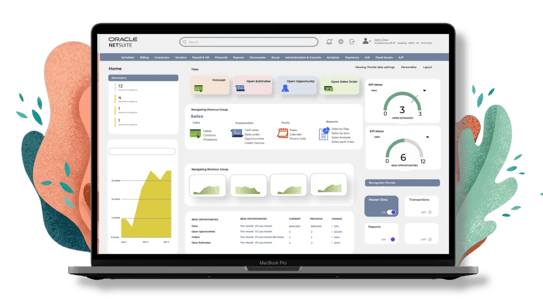 Modern enterprise platforms reduce these barriers by providing cross-functional visibility, real-time data, and shared context. A cloud ERP like Oracle NetSuite does more than centralize operations it connects finance, sales, procurement, inventory, and analytics in a single environment.
This transforms decision-making because:
- Information is consistent and available in real time.
- Risks are identified before they materialize.
- Teams make aligned decisions, not siloed ones.
The organization stops reacting to results and starts anticipating them.
Oracle NetSuite as a platform for modern decisions
With its cloud-native architecture, Oracle NetSuite delivers real-time financial and operational visibility, customizable dashboards, and analytical capabilities that allow scenario evaluation without manual processes.
By integrating operations and finance, NetSuite reduces analysis paralysis, eliminates data fragmentation, and enables faster, more collaborative, and more reliable decisions. Technology becomes a competitive advantage instead of a constraint.
The role of Efficientix in this process
Technology alone does not guarantee better decisions. The difference lies in how it is implemented and governed.
At Efficientix, we help companies design operating models that truly work on NetSuite. It’s not just about activating modules it’s about aligning processes, metrics, and roles so information flows clearly and decisions are made with confidence.
The goal is for NetSuite not only to record what happened, but to help decide what to do next.
Conclusion
Companies that make better decisions are not the ones with more data, but the ones with less friction between information, analysis, and action.
Avoiding critical mistakes in business decision-making requires clear objectives, defined processes, and a platform that connects the entire operation. Oracle NetSuite, when properly implemented, delivers exactly that balance.